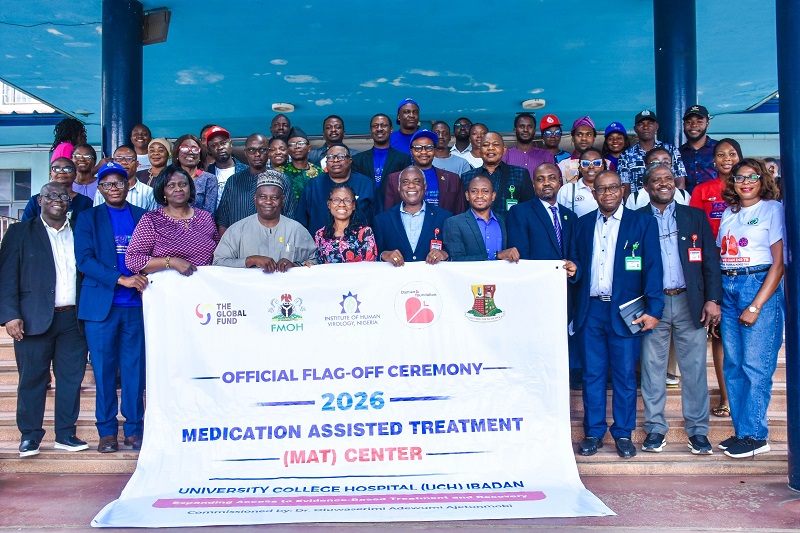
In a strategic move to address the growing challenge of opioid dependence, the University College Hospital, Ibadan, in partnership with the Oyo State Ministry of Health, formally flagged off the Medication-Assisted Treatment (MAT) programme on Tuesday, March 24, 2026, at the hospital’s boardroom.
The event was led by the Chief Medical Director, Prof. Jesse Abiodun Otegbayo, alongside the Honourable Commissioner for Health, Dr. Oluwaserimi Ajetunmobi, underscoring a strong commitment to tackling substance use disorders through evidence-based interventions.
What is Medication-Assisted Treatment (MAT)?
Medication-Assisted Treatment (MAT) is a globally recognized, evidence-based approach to treating opioid dependence. It combines:
FDA-approved medications (such as methadone or buprenorphine)
Behavioral therapies and counseling
Long-term recovery support systems

This integrated approach not only reduces withdrawal symptoms and cravings but also significantly lowers the risks of relapse, overdose, and the transmission of infectious diseases such as HIV and hepatitis.
Stakeholders Highlight Importance of Collaboration
In his welcome address, the MAT Site Coordinator, Dr. Victor Makanjuola, expressed appreciation to key stakeholders for their unwavering support and commitment to the programme.
He emphasized that the initiative is structured to deliver comprehensive, patient-centered care, addressing both the physical and psychological aspects of opioid dependence.
Similarly, the National Coordinator of Harm Reduction, Dr. Jimoh Salaudeen (MNI), stressed the importance of multi-sectoral collaboration. He called on healthcare professionals, government agencies, and community stakeholders to adopt integrated strategies that go beyond harm prevention to include sustainable recovery and relapse prevention mechanisms.
Government’s Perspective on Harm Reduction
Speaking at the event, Dr. Oluwaserimi Ajetunmobi highlighted the significance of the MAT programme as a core component of harm reduction.
According to her, harm reduction represents one of the three critical pillars of drug control:
Supply reduction
Demand reduction
Harm reduction
She noted that the MAT programme acknowledges the realities of addiction by focusing on minimizing health risks such as:
HIV and hepatitis transmission
Drug overdose
Other substance-related complications
Her remarks reinforced the state government’s commitment to adopting progressive, health-centered approaches to drug control.
Call for Sustainability and Local Adaptation
In his keynote remarks, Prof. Jesse Abiodun Otegbayo challenged stakeholders to prioritize the long-term sustainability of the MAT programme.

He emphasized the need to:
Align international harm reduction standards with local realities
Ensure continuous funding and institutional support
Build capacity among healthcare providers
Promote community acceptance and awareness
His call to action highlights the importance of designing solutions that are not only effective but also adaptable within Nigeria’s healthcare ecosystem.
Implications for Healthcare Delivery in Nigeria
The launch of the MAT programme at UCH represents a major step forward in:
Expanding access to addiction treatment services
Reducing the burden of substance use disorders
Strengthening public health interventions
Improving patient outcomes through evidence-based care
As opioid dependence continues to pose a significant public health challenge, initiatives like this position UCH and Oyo State as leaders in innovative healthcare delivery and harm reduction strategies in Nigeria.
Conclusion
The flag-off of the Medication-Assisted Treatment (MAT) programme by Prof. Jesse Abiodun Otegbayo and Dr. Oluwaserimi Ajetunmobi marks a transformative step in addressing opioid dependence in Nigeria.
By integrating medication, counseling, and collaborative healthcare strategies, the programme sets a strong foundation for sustainable recovery, improved public health outcomes, and a more compassionate approach to addiction treatment.